
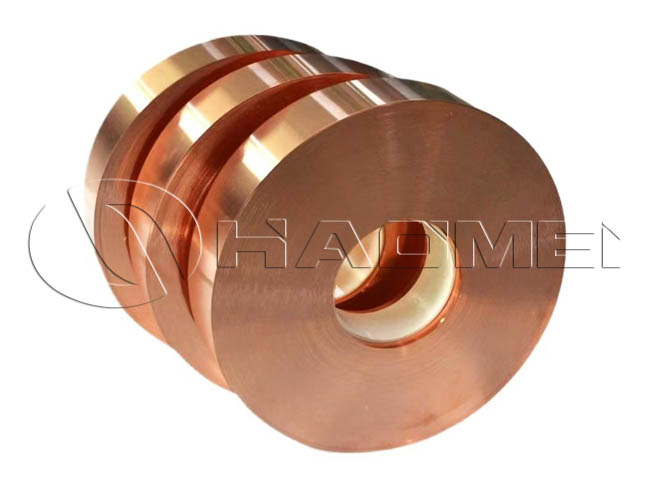
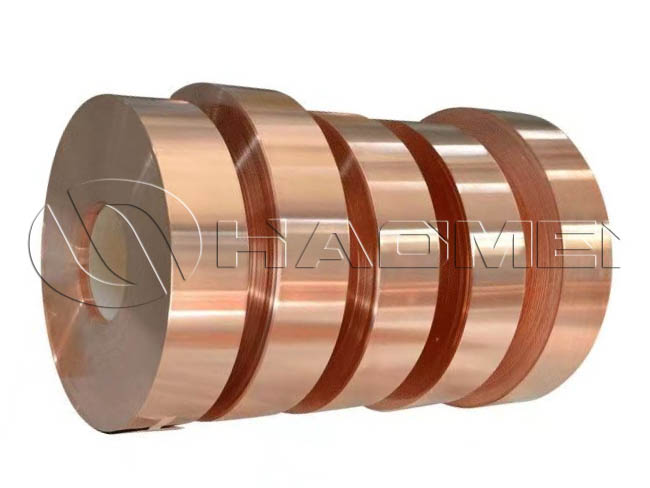
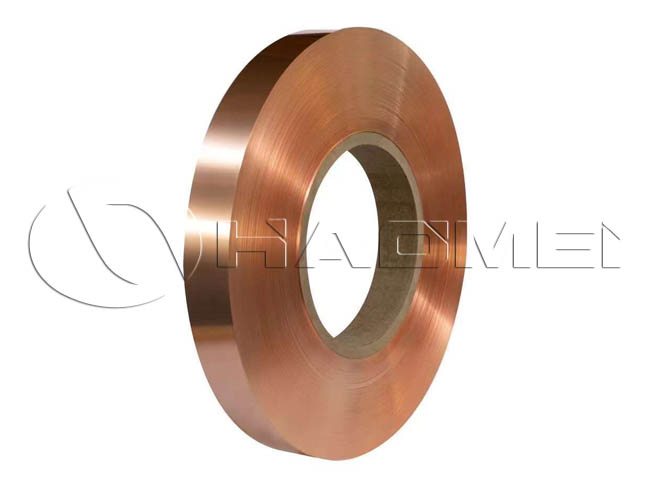
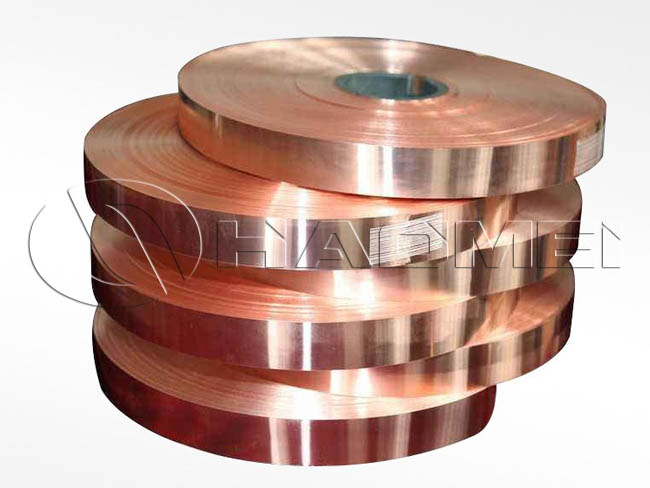
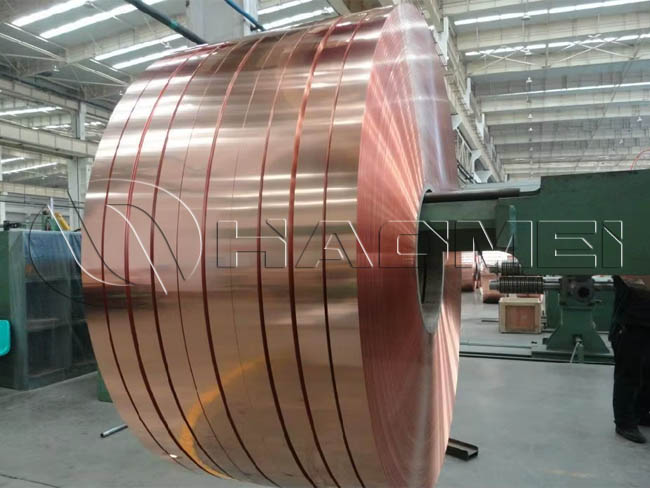
Transformer Winding Copper Strip
High-quality transformer copper strip with excellent conductivity and precise tolerances. Suitable for transformer windings, ensuring low loss, high efficiency, and reliable performance. Custom sizes are available to meet the needs of global industrial applications.
- Alloy:C1100
- Thickness:0.2–3.0 mm
- Width:50–1350 mm
- Electrical Conductivity:≥99% IACS
- Tensile Strength:>193 MPa
In the field of power equipment manufacturing, the performance and reliability of transformers depend greatly on the quality of conductive materials. As one of the core materials for windings, transformer copper strip has become the preferred conductor material for high-end transformer manufacturing due to its excellent electrical conductivity, stable mechanical properties, and good processing adaptability. It is widely used in dry-type transformers, oil-immersed transformers, reactors, and various types of power equipment.
Product Details
Transformer copper strip is a flat strip coil material made from high-purity electrolytic copper, with a copper content of ≥99.97%. It is processed through melting, hot rolling, cold rolling, precision annealing, surface cleaning, and slitting. Typical thickness ranges from 0.1 mm to 3.0 mm, and width generally ranges from 30 mm to 1500 mm. The edges can be rounded and the size can be customized according to transformer design requirements.
C1100 copper strip is commonly used in transformer winding processes because of its low impurity content and high conductivity of over 99.8% IACS. It offers high electrical conductivity, durability, and ductility. C1100-grade copper strip for transformer windings is commonly used in transformers, reactors, filters, and instrument transformers.
Unlike round copper wire, copper strip is wound directly into low-voltage windings with a flat cross-section, which can significantly improve space utilization and current-carrying capacity.
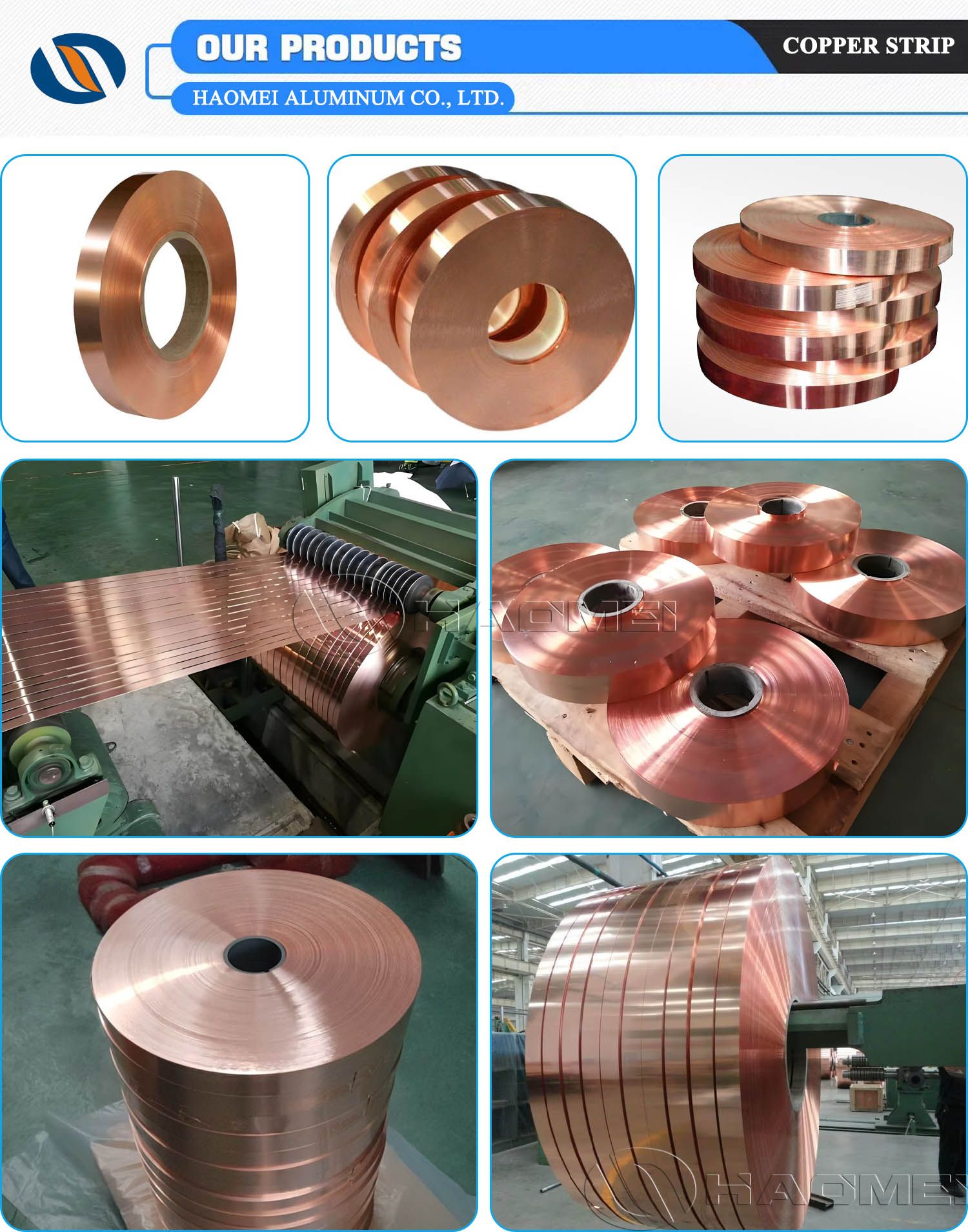
Transformer Copper Strip Specifications
| Grade | GB | JIS | ASTM | |||
| TU0, TU1, TU2, T2 | C1020, C1100 | C10200, C10300, C11000 | ||||
| Standards | GB/T18813, JIS H3100, ASTM B152 | |||||
| Main Applications | Mainly used to replace copper wire for winding foil-wound transformers, transformer flexible connections, amorphous alloy transformers, etc. | |||||
| Thickness (mm) | 0.09-0.15 | 0.15-0.3 | 0.3-0.6 | 0.6-1.2 | 1.2-2.0 | |
| Tolerance | ±0.005 | ±0.008 | ±0.01 | ±0.02 | ||
| Width (mm) | 30-600 | 50-600 | 60-600 | 80-600 | ||
| Tolerance | ≤400 ±0.1,400-600 ±0.3 | |||||
| Tensile Strength | ≥200 / ≥230 MPa | |||||
| Elongation | ≥20% / ≥30% | |||||
| Hardness | 50–75 HB | |||||
| Conductivity | ≥99.80% IACS | |||||
| Surface Treatment | Rolled surface; the strip surface is smooth, free from scratches and impurities. | |||||
| Paper Core Inner Diameter | Paper cores with diameters of 150 mm, 300 mm, 400 mm, and 500 mm are available. Special inner-diameter paper cores and coreless coils can also be provided upon request. | |||||
| Packaging | Wooden pallet / wooden case | |||||
| MOQ | 1-3 tons | |||||
Chemical Composition of Transformer Winding Copper Strip
| C1100/C11000 Copper Strip Chemical Composition (%) | ||||||||
| Element | Cu+Ag | Sn | Zn | Pb | Ni | Fe | As | O |
| Standard Value | ≥99.90 | ≤0.002 | ≤0.005 | ≤0.005 | ≤0.005 | ≤0.005 | ≤0.002 | ≤0.06 |
Transformer Winding Copper Strip Grades Comparison
| Industry Standard | USA | Italy | China | Euronorm | Japanese |
| Standard | ASTM B5, B152 | UNI 5649 | GB/T | EN 1652 / DIN 1976 | JIS |
| C1100 | C11000 | Cu-ETP | T2 | CW004A / E-Cu 58 | C1100 |
Main Features of Transformer Copper Strip
1. High Electrical Conductivity
The volume conductivity of copper strip is ≥99% IACS, with low electrical resistivity. It can effectively reduce copper loss, also known as load loss, during transformer operation, improve energy efficiency, and meet national Grade 1 and Grade 2 energy-efficiency standards.
2. Excellent Thermal Conductivity
The thermal conductivity of copper is approximately 385 W/(m·K), much higher than that of aluminum. Under overload or high-temperature operating conditions, copper strip can quickly transfer heat from inside the winding to the insulation layer or cooling medium, reducing hot-spot temperature rise and extending insulation life.
3. High Mechanical Strength
The tensile strength of copper strip is typically 240–300 MPa, with high yield strength. Combined with its flat-strip structure, the winding has high compactness after forming. In the event of a sudden short circuit, it can withstand stronger electromagnetic forces and is less likely to deform or break, ensuring safe transformer operation.
4. Fine Edge Treatment
High-quality copper strip is processed with chamfered or rounded edges, free from burrs and sharp corners. It will not puncture inter-turn insulation and is especially suitable for multi-layer winding or foil-type winding structures.
5. Flexibility and Consistency
After full annealing, O-temper copper strip has good bending performance and can be continuously and tightly wound. A single coil length can reach hundreds to thousands of meters. Thickness tolerance can be controlled within ±0.01 mm, and width tolerance within ±0.1 mm.
Application Scenarios
Low-voltage windings of dry-type transformers: Foil-wound structure, using copper strip instead of multiple small wires, with only one layer of DMD or NOMEX insulation between layers.
Oil-immersed distribution transformers: Copper strip is used on the low-voltage side to improve short-circuit resistance.
Reactors and filter inductors: An ideal material for high-current flat coils.
New energy vehicle charging module transformers: Suitable for high-frequency, high-current, and compact designs.
Medium-frequency furnaces and rectifier transformers: Suitable for applications requiring high utilization efficiency of conductive cross-sectional area.
Copper Strip Manufacturing Process
Raw Material Selection: Electrolytic copper billets are selected and subjected to chemical analysis and conductivity testing.
Cold Rolling: High-precision cold rolling mills are used to achieve accurate thickness control.
Annealing: High-temperature annealing is carried out in a protective atmosphere to optimize the grain structure.
Surface Finishing: Belt sanding equipment is used to obtain a smooth surface.
Slitting: Ensures neat edges without burrs.
Quality Inspection: 100% conductivity testing, mechanical property testing, and dimensional tolerance inspection.
How to Get the Price of Transformer Copper Strip
To obtain a quotation for copper strip, please provide the following information:
Quantity, in kg or tons
Dimensions: thickness × width × coil length
Material grade, such as C11000
Edge type: deburred / rounded
Coil inner diameter: 200 mm / 300 mm / 400 mm / 500 mm
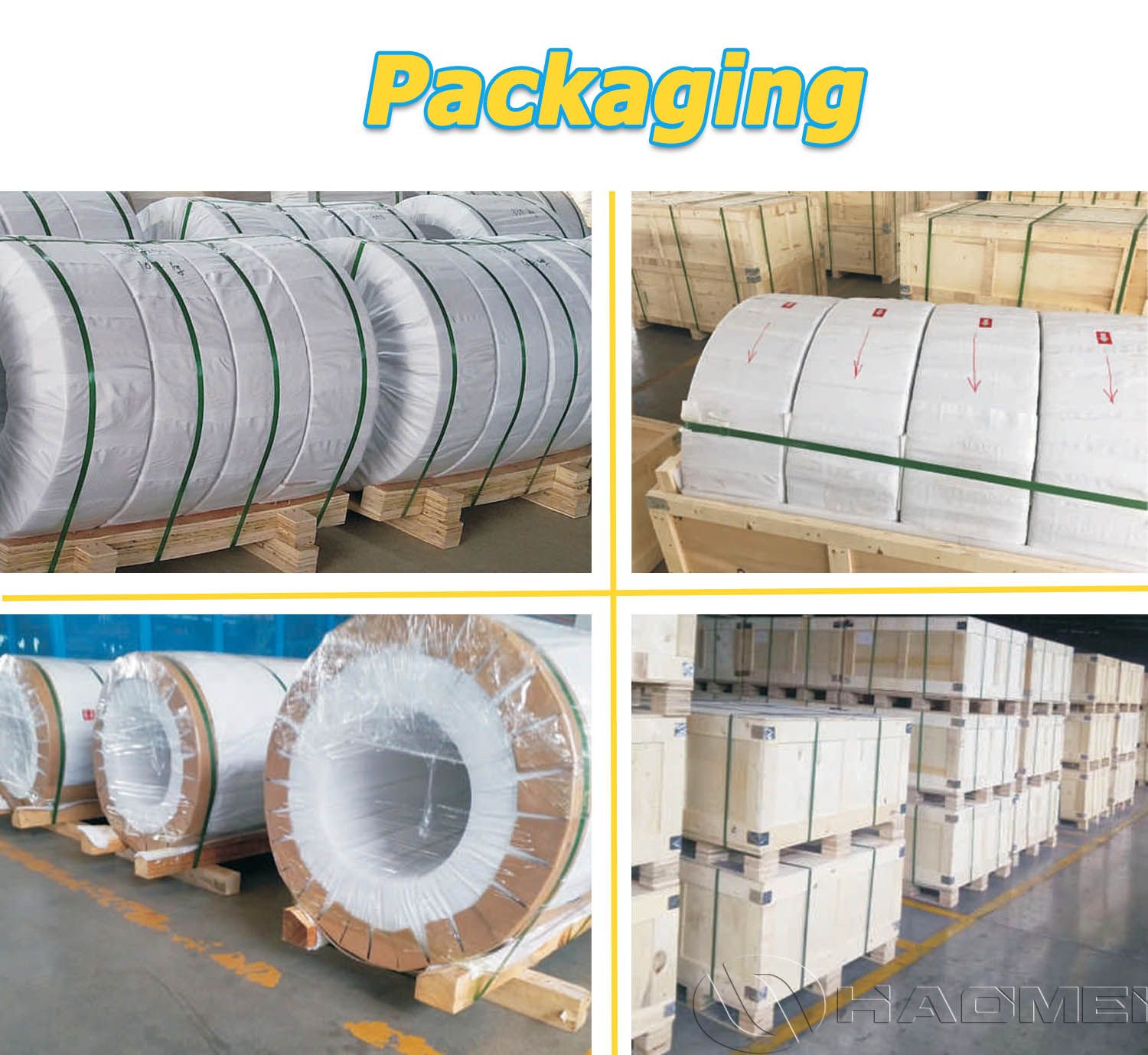
Packaging and Delivery of Transformer Copper Strip
Copper strip is usually packaged with moisture-proof and oxidation-resistant materials:
Inner layer: anti-rust paper
Outer layer: wooden case / steel strap reinforcement
Coil packaging or small slit coils are available
Customized packaging specifications are available according to customer requirements
FAQ
Q1: What materials are commonly used for transformer copper strip?
A: Common materials include T2, C1100, TU1, and oxygen-free copper, or OFC. Among them, oxygen-free copper has higher purity and more stable conductivity, making it suitable for high-end power equipment.
Q2: What is the main difference between copper strip and aluminum strip in transformers?
A: Copper strip has higher conductivity and lower resistance, resulting in lower losses under the same current-carrying conditions, but its cost is higher. Aluminum strip is lighter and less expensive, but requires a larger cross-section to meet conductivity requirements.
Q3: What temper is generally used for transformer copper strip?
A: Most winding applications use O-temper, or soft temper, copper strip to ensure good flexibility and winding performance. Semi-hard or hard temper may be used for certain special structures.
Q4: Does the copper strip surface require special treatment?
A: Generally, the surface should be smooth, free from oxidation, and free from oil contamination to ensure good insulation coating performance. If required, tin plating or coating treatment can be applied.
Q5: Can the product be customized?
A: Yes. Thickness, width, hardness temper, and packaging form can be customized according to customer requirements to meet different transformer design needs.
Q6: How is the conductivity of copper strip guaranteed?
A: By selecting high-purity raw materials, such as ≥99.99% cathode copper, and strictly controlling the annealing process, conductivity can be ensured to reach or exceed the 98% IACS standard.
Tags
- Oil-Immersed Transformer Windings Copper Strip
- How to Choose the Thickness of Transformer Winding Copper Strip?
- Hot-Rolled Copper Strip for Transformer Windings
- Why Copper Strip Is the Best Material for Transformer Windings
- Pure Copper Strip (C11000) for Power Transformers
- High-Conductivity C1100 ETP Soft Annealed Copper Strip for Transformer Windings
- Copper Strip for Dry-Type Transformer Windings
- C11000 O Temper Copper Strip for Transformers
- High-Conductivity Pure Copper Strip for Transformer Windings, 100% IACS
- High-Conductivity Copper Strip for Distribution Transformer Windings
- Can T2 Copper Strip Be Used for Transformer Windings?
- Low-Resistance Soft Copper Strip for Solar Transformer Windings