 Contact Us
In transformer manufacturing, the choice of winding material directly affects electrical conductivity, temperature rise control, operational stability, and service life. Common transformer winding materials mainly include copper and aluminum. Among them, copper strip is widely used in power transformers, dry-type transformers, special transformers, and high-frequency transformers due to its excellent electrical conductivity, thermal conductivity, mechanical strength, and long-term reliability.
Compared with traditional round copper wire or aluminum wire windings, copper strip offers systematic advantages in electrical performance, thermal management, and structural stability. Therefore, it is widely regarded as one of the best material forms for transformer windings.
Material Characteristics of Copper Strip
| Property | Description |
| High Conductivity | Reduces power loss caused by heating in transformers, resulting in higher efficiency and lower operating costs. |
| Dielectric Strength | Helps prevent current leakage, which is important for insulation between copper foil layers. |
| Purity | Must be highly pure, at least 99.9%, to maintain excellent electrical and mechanical properties. |
| Corrosion Resistance | Helps transformers operate reliably and extends service life, even in harsh environments. |
What Is Copper Strip in Transformers?
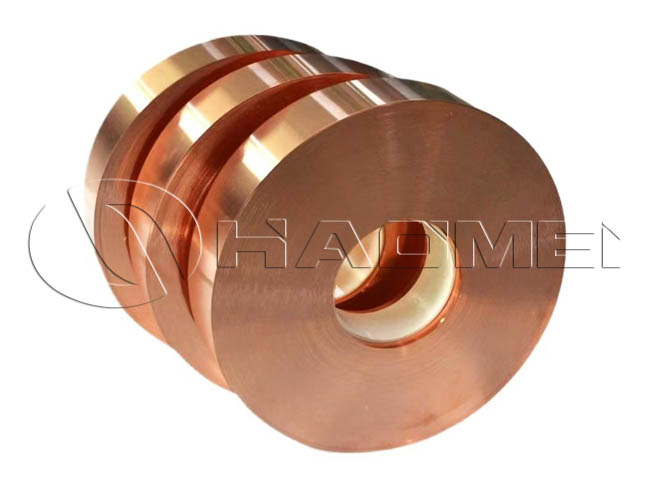
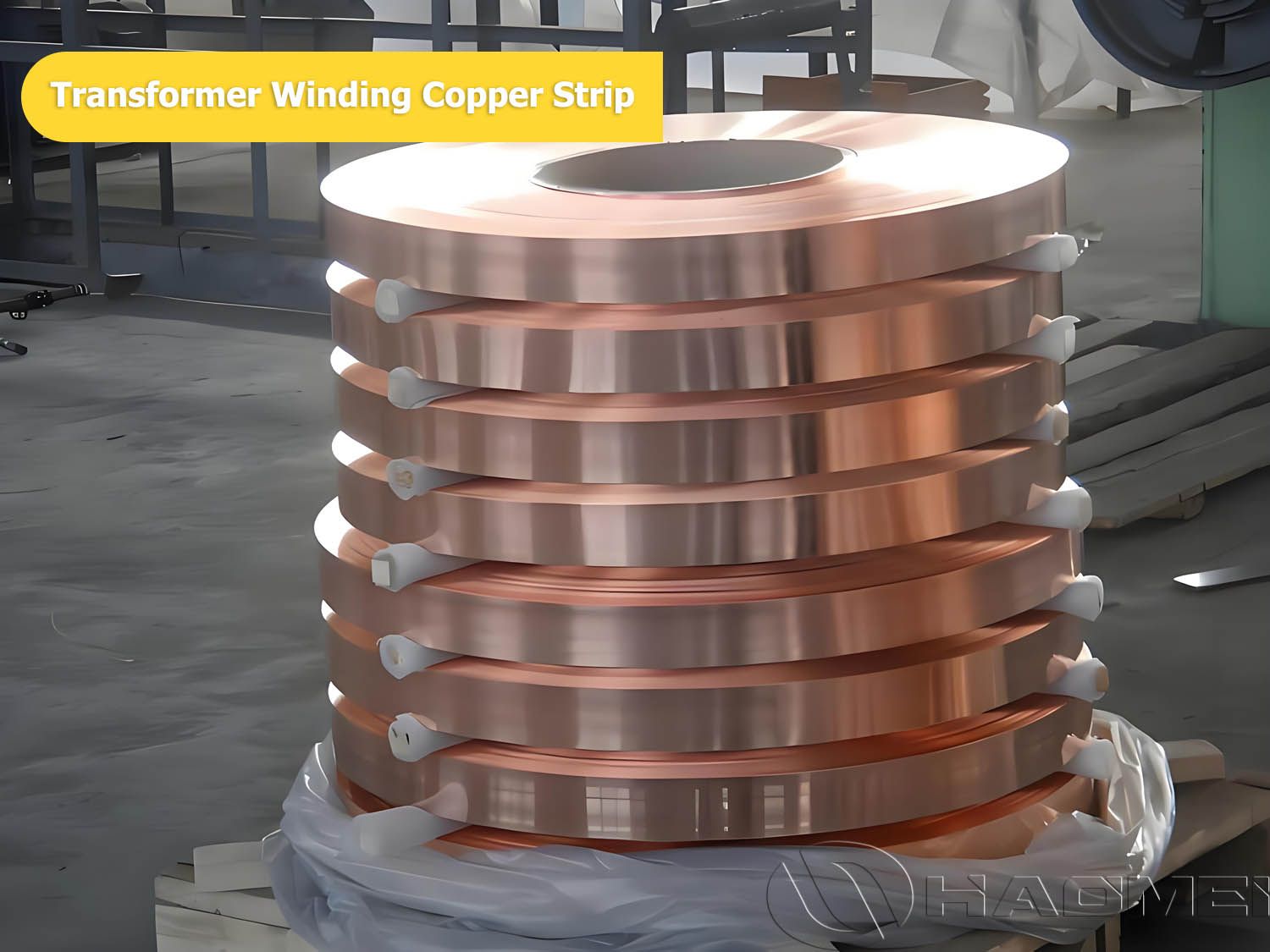
Copper strip for transformer windings is a highly conductive copper material specially used for low-voltage or high-current windings in power transformers. It is usually made from high-purity electrolytic copper, such as T2 / C11000 or equivalent oxygen-free copper, through precision rolling. It features excellent electrical conductivity, precise dimensional tolerance control, and stable mechanical properties, making it one of the core conductive materials in high-end transformer manufacturing.
This product is widely used in oil-immersed transformers, dry-type transformers, rectifier transformers, and special power equipment. It is especially suitable for applications requiring high efficiency, good temperature rise control, and long-term operational reliability.
Typical Technical Parameters
| Item | Parameter Range |
| Material | T2 / C11000, etc. |
| Material Standard | ASTM B187 / EN 13601 |
| Purity | ≥ 99.90% Cu |
| Conductivity | ≥ 101% IACS |
| Thickness Range | 0.1 mm – 3.0 mm |
| Width Range | 10 mm – 1000 mm, customized slitting available |
| Temper | Soft annealed (O), half-hard (1/2H), hard (H) |
| Tensile Strength | 200 – 360 MPa, depending on temper |
| Elongation | ≥ 20%, higher for soft annealed temper |
| Surface Treatment | Bright surface / insulated coating / tin plating available |
| Form | Coil or fixed-length strip |
| MOQ | 1–3 tons |
1. Electrical Performance: A Loss-Reduction Expert for High-Frequency and High-Current Applications
The core function of transformer windings is to transmit electrical energy efficiently, and reducing losses is the primary criterion for evaluating winding materials. Copper strip offers irreplaceable advantages in this regard.
(1). Extremely High Conductivity
Copper is an excellent conductor, second only to silver. The conductivity of transformer-grade copper strip can reach more than 98% IACS, while oxygen-free copper, such as TU1, can even exceed 100% IACS. This means that when carrying the same current, copper strip has very low resistance loss, also known as copper loss. This directly results in less heat generation and higher operating efficiency.
(2.) Effective Suppression of the Skin Effect
This is one of the most important advantages of copper strip compared with round conductors. Under high-frequency alternating current, current tends to flow near the surface of the conductor. This phenomenon is known as the "skin effect," which causes the equivalent resistance of the conductor to increase significantly as frequency rises.
Copper strip has a flat shape and relatively thin thickness, usually from 0.1 mm to 2.5 mm. By selecting a thickness that matches the current skin depth, the conductor cross-section can be used more effectively, greatly reducing AC resistance at high frequencies and controlling power loss. This is a key technical reason why copper strip performs well in high-frequency, high-power transformer applications.
2. Mechanical and Structural Properties: Compact, Stable, and Short-Circuit Resistant
In addition to good electrical conductivity, transformer windings must also withstand strong electromagnetic forces and thermal stress. Copper strip also has outstanding advantages in structural performance.
(1). High Space Utilization and Compact Structure
Windings made from copper strip have a high axial and radial filling factor, allowing better use of the limited window space inside the transformer. With the same conductive cross-sectional area, copper strip can produce a more compact coil structure, which helps reduce transformer size.
(2). Strong Short-Circuit Resistance
Short-circuit resistance is critical to transformer safety. When a sudden short circuit occurs, a huge surge current generates extremely strong electrodynamic forces.
Low-voltage foil windings made from copper strip have strong structural integrity. Since the axial direction is typically formed as one turn, there is almost no axial force caused by a helical angle. As a result, the short-circuit resistance is excellent.
At the same time, copper has a melting point of up to 1083°C, much higher than aluminum and many other materials. Under the thermal shock of a short-circuit event, copper is less likely to soften or deform, further ensuring equipment safety.
3. Processing and Reliability: Designed for High-Quality Manufacturing
The advantages of a material must ultimately be reflected through manufacturing. Copper strip also performs excellently in processing and practical application.
(1). Suitable for Fully Automatic Winding with Stable Quality
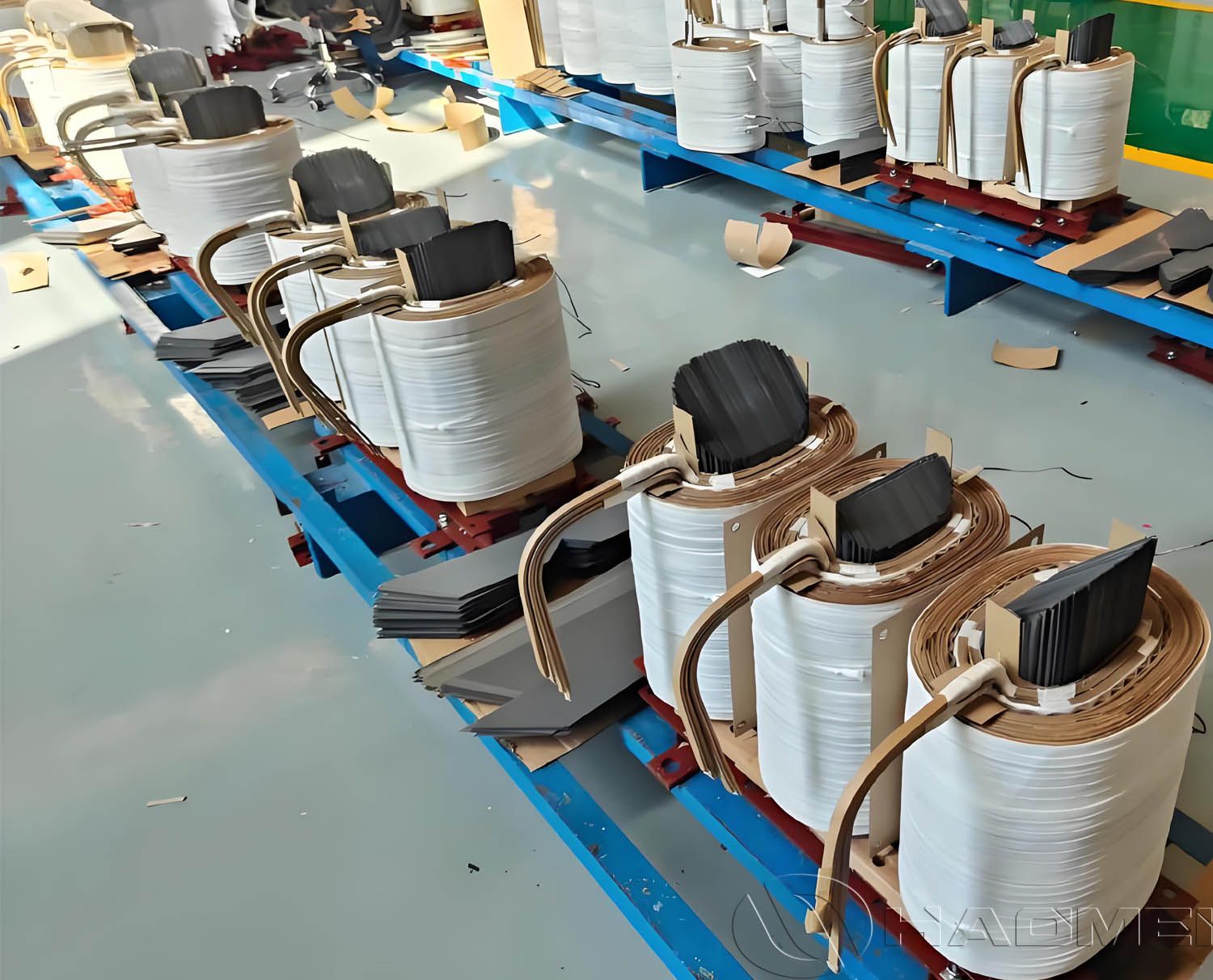
Copper strip winding is very suitable for fully automatic foil winding machines. Interlayer insulation materials, such as polyester film, can be wound synchronously with the copper strip. This enables high production efficiency, excellent coil dimensional accuracy, and outstanding product consistency.
This standardized and automated process is difficult to match with traditional manual winding methods.
(2). Excellent Heat Dissipation
Copper itself is an excellent thermal conductor. In copper strip windings, the copper strip and insulation layers fit closely together, allowing heat generated inside the winding to be quickly conducted to the surface and dissipated.
In dry-type transformers, some designs use the structure of copper strip windings to form ventilation ducts, further improving heat dissipation efficiency. This effectively reduces local overheating and extends insulation life.
Application Fields
Transformer winding copper strip is mainly used in:
Low-voltage windings of oil-immersed power transformers
Foil windings of dry-type transformers
High-current windings of rectifier transformers
Wind power and photovoltaic new energy transformers
Industrial power supplies and electrical equipment
What Are the Advantages of Copper Strip Compared with Aluminum Strip?
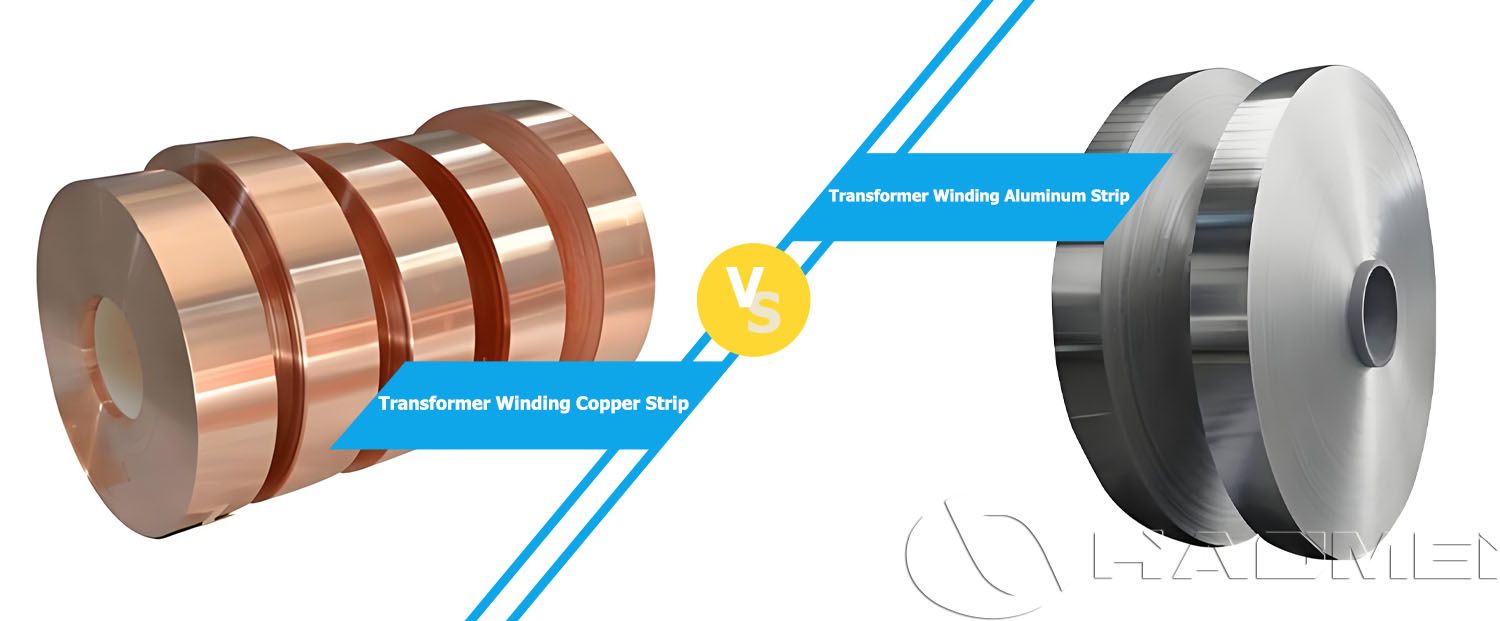
Aluminum strip is also a common material for transformer windings, especially in products where cost control or weight reduction is important. However, in terms of overall performance, copper strip has advantages in many key aspects.
1. Higher Conductivity
Copper has better electrical conductivity than aluminum. When carrying the same current, aluminum strip usually requires a larger cross-sectional area to achieve resistance similar to that of copper strip. This increases winding volume and occupies more transformer window space.
Copper strip can achieve lower resistance with a smaller cross-sectional area, which helps reduce losses and decrease transformer size.
2. Better Mechanical Strength
Copper generally has better mechanical strength and creep resistance than aluminum. During long-term transformer operation, windings are subject to thermal stress, electrodynamic forces, and mechanical vibration. Copper strip windings are more likely to maintain structural stability.
3. More Reliable Connections
Aluminum surfaces easily form an oxide film, so connection processing requires stricter control. If the process is not properly managed, high contact resistance may occur at the joint.
Copper strip is easier to weld and connect electrically, and its joints are more stable and reliable.
4. More Stable Long-Term Operation
Because copper strip performs well in electrical conductivity, thermal conductivity, strength, and connection reliability, it is more suitable for transformers requiring high reliability, high load rates, and long service life.
Of course, aluminum strip for transformer windings also has advantages such as light weight and low cost. In actual material selection, product positioning, operating conditions, and budget should be considered comprehensively. However, for transformers requiring high efficiency and high reliability, copper strip is often the better choice.
How to Choose the Right Copper Strip for Transformer Windings
1. Material and Purity: The Foundation of Conductivity
Electrical-grade pure copper should be preferred. Oxygen-free copper, such as TU1 and TU2, or high-grade pure copper such as T2 should be selected.
The key indicator is conductivity. The conductivity should reach above 100% IACS to ensure low loss and low heat generation from the source.
2. Temper and Hardness: The Key to Winding
O temper, also known as fully annealed soft temper, is usually preferred for transformer copper strip.
The reason is that O-temper copper strip has moderate tensile strength and excellent elongation. It is easy to bend and fit tightly on winding machines, and it has low springback after winding. This helps prevent damage to interlayer insulation paper.
3. Dimensions: Electromagnetic Matching
Thickness: 0.1 mm – 3.0 mm
The thickness should be selected according to the operating frequency and skin depth of the transformer. The higher the frequency, the thinner the copper strip should be in order to suppress high-frequency eddy current losses.
Width:
The width is usually determined directly by the axial design height of the transformer coil. Full-width winding helps ensure uniform current distribution.
4. Surface and Edge Quality: Protection for Insulation
The edges must be chamfered or rounded. Any burrs are strictly prohibited. Under the pressure of short-circuit electrodynamic forces, sharp burrs can easily puncture the interlayer insulation paper, resulting in interlayer short circuits and coil failure.
The surface should be flat and smooth, free from oxidation spots, oil stains, scratches, dents, or pits. This ensures perfect bonding and contact with insulation materials.
Packaging and Supply Forms
To ensure transportation and processing quality, copper strip is usually supplied with:
Moisture-proof and anti-oxidation packaging, such as vacuum or dry packaging
Wooden pallets or steel-strip reinforced packaging
Moisture-proof paper lining and PE film protection
Fixed-length coils, split coils, or full coils according to customer requirements