 Contact Us
In transformer manufacturing, the choice of winding material directly determines the electrical conductivity, temperature rise control, operating efficiency, and service life of the equipment. Many purchasing managers, engineers, and equipment manufacturers often ask the same question when selecting materials:
Can T2 copper strip be used for transformer windings?
The answer is: Yes. T2 copper strip is not only suitable for transformer windings, but it is also a mature and widely used material in foil-wound transformers.
What Is T2 Copper?
T2 copper is a type of industrial pure copper, also known as red copper, with a copper content of Cu + Ag ≥ 99.90%. Its corresponding international grades include C11000 in the United States and SE-Cu in Germany.
T2 copper has an electrical conductivity of up to 98%–101% IACS — International Annealed Copper Standard — and its resistivity is lower than 0.017241 Ω·mm²/m.
In terms of mechanical properties, T2 copper strip has:
Tensile strength: ≥195 MPa
Elongation: ≥35%
Vickers hardness: 45–65 HV
This means it has sufficient strength to withstand tension during the winding process, while also offering excellent ductility for complex forming operations.
Copper Strip vs. Copper Wire: Why Choose T2 Copper Strip?
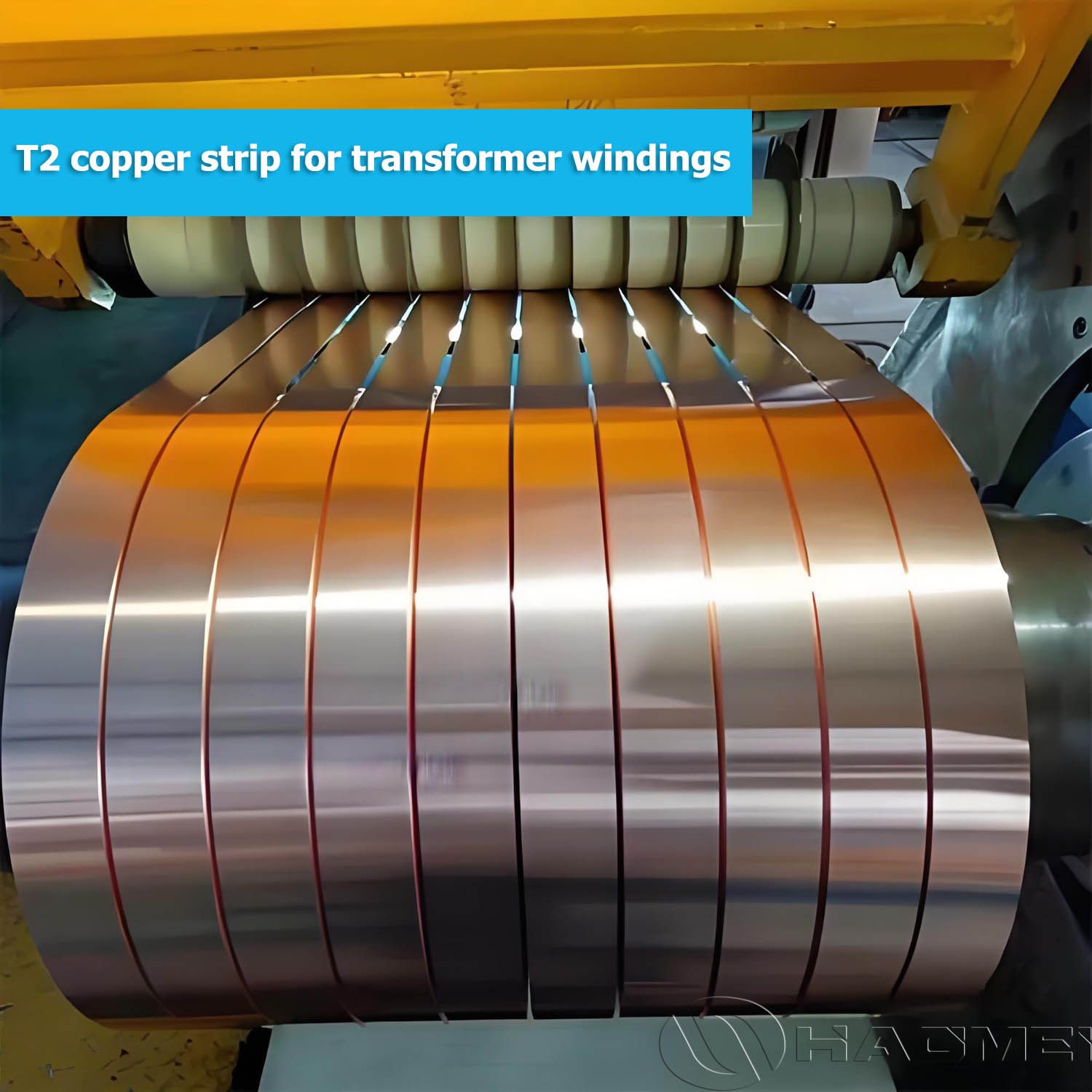
Traditional transformer windings often use round copper wire. However, copper strip, also known as copper foil in some applications, is increasingly replacing copper wire due to several key advantages.
1. A Natural Solution to Skin Effect
Under high-frequency and high-current conditions, skin effect causes current to concentrate on the conductor surface, leaving the center portion underutilized.
Copper strip is a flat conductor. Its surface-area-to-cross-section ratio is much larger than that of round wire, which significantly reduces the influence of skin effect.
For high-frequency transformers, this is a major performance improvement.
2. Better Heat Dissipation
Copper strip provides excellent electrical conductivity, thermal conductivity, and heat dissipation performance.
During transformer operation, heat can be conducted away from the winding more quickly, reducing temperature rise and extending equipment service life.
3. More Compact Structure and Higher Efficiency
Using copper strip to wind transformer coils can simplify the manufacturing process, greatly reduce production costs, save resources, and significantly improve production efficiency.
Transformers wound with copper strip have stable quality and have been increasingly adopted in both dry-type transformers and oil-immersed transformers.
4. More Reliable Insulation Compatibility
The expansion coefficient of the insulation layer used with copper strip is close to that of the copper conductor itself.
As a result, during temperature changes, the insulation layer is less likely to crack or peel off, improving long-term reliability.
Typical Technical Parameters of Copper Strip for Transformer Windings
| Item | Parameter |
| Material Grade | T2 C11000 |
| Copper Content | ≥99.90% |
| Electrical Conductivity | ≥100% IACS |
| Thermal Conductivity | Approx. 390 W/m·K |
| Temper | O soft, H hard |
| Thickness | 0.08–5.00 mm |
| Width | 10–600 mm customizable |
| Length | 1000–16000 mm customizable |
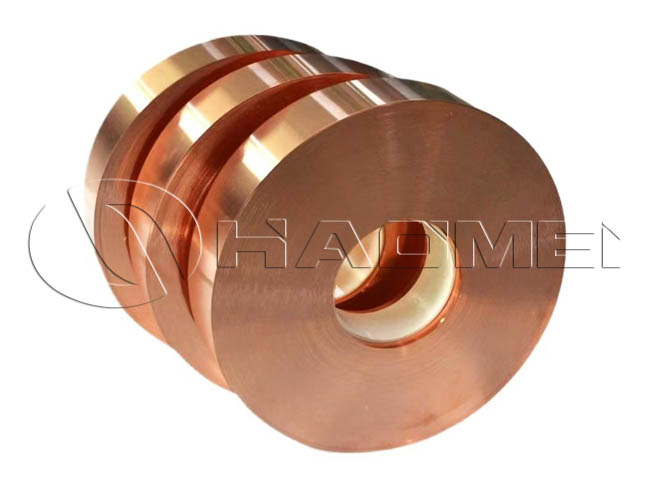
| Surface | Bright, free from oxidation, cracks, and burrs |
| MOQ | 3 tons |
Main Advantages of T2 Copper Strip for Transformer Windings
1. Excellent Electrical Conductivity
T2 copper strip has an electrical conductivity of 98%–101% IACS, second only to silver among commonly used metals.
With the same cross-sectional area, it has lower resistance, which significantly reduces copper loss — I²R loss - and improves transformer operating efficiency.
Compared with aluminum strip, copper strip can reduce the required conductor cross-sectional area by about 40% under the same current-carrying capacity.
2. Excellent Heat Dissipation Capability
T2 copper has a thermal conductivity of approximately 400 W/m·K. Combined with the large heat dissipation area provided by its flat structure, the winding temperature rise can be significantly reduced.
This is crucial for extending transformer insulation life. In general, for every 10°C reduction in temperature, the insulation life can be approximately doubled.
3. Effective Suppression of Skin Effect
Under high-frequency and high-current conditions, current tends to flow along the conductor surface.
Copper strip has a large width-to-thickness ratio and a much higher surface-area-to-cross-section ratio than round copper wire. This allows current distribution to become more uniform, greatly improving effective cross-section utilization and significantly reducing high-frequency losses.
4. High Winding Efficiency and Compact Structure
Copper strip can be continuously wound using automated equipment, with neat layer arrangement and much higher production efficiency than manual winding with copper wire.
Foil-type windings feature low interlayer voltage, small end leakage flux, and compact structure, making them especially suitable for dry-type transformers and amorphous alloy transformers.
5. Strong Short-Circuit Resistance
Windings made with copper strip have high mechanical strength. When sudden short circuits occur, they can better withstand electrodynamic impact compared with copper wire windings, resulting in higher operating reliability.
6. Outstanding Overall Cost Performance
Compared with TU1 oxygen-free copper, T2 copper strip is more cost-effective, while its performance is sufficient for most conventional transformer applications, including distribution transformers, dry-type transformers, and oil-immersed transformers.
It is a mature material recognized by the Chinese national standard GB/T 18813-2014.
Can T2 Copper Strip Be Used for Transformer Windings?
Yes.
From the perspective of material properties, T2 copper strip fully meets the basic requirements for use as a conductor material in transformer windings.
It has high copper content and good electrical conductivity, making it suitable for many types of windings, including:
Power transformers;
Distribution transformers;
Dry-type transformers;
Oil-immersed transformers;
Reactors;
Special transformers.
T2 copper strip is especially common in medium- and low-voltage transformers, distribution equipment, and general industrial transformers.
However, it should be noted that "can be used" does not mean "suitable for every application without further evaluation."
For high-end transformers, high-frequency transformers, special-environment equipment, or projects with stricter requirements for gas content, oxygen content, and electrical conductivity, oxygen-free copper strip, silver-bearing copper strip, or other special copper materials may be selected.
Typical Applications of C11000 Copper Strip in Transformers
Thanks to its excellent electrical conductivity and mechanical properties, C11000 copper strip is widely used in:
Oil-immersed power transformers;
Dry-type transformers;
Distribution transformers;
Furnace transformers;
Rectifier transformers;
Photovoltaic step-up transformers;
Wind power transformers;
Reactors;
High-voltage electrical equipment;
New energy storage systems.
With the rapid development of new energy and smart grid construction, market demand for C11000 copper strip continues to grow.
Quality Requirements for Copper Strip Used in Transformer Windings
Transformer windings are exposed to current, temperature rise, electromagnetic force, and mechanical stress over long periods of operation. Therefore, the quality requirements for copper strip are very strict.
High-quality T2 copper strip can not only improve transformer efficiency, but also effectively reduce operating losses and extend equipment service life.
Generally, transformer winding copper strip should meet the following requirements.
1. Chemical Composition Purity
Transformer copper strip is highly sensitive to impurity content, which must be strictly controlled.
| Element / Indicator | Requirement for T2 Copper Strip | Risk If Exceeded |
| Copper + Silver Content | ≥99.90% | Reduced conductivity and increased losses |
| Arsenic As | ≤0.002% | Increased cold brittleness, affecting winding performance |
| Antimony Sb | ≤0.002% | Reduced conductivity and corrosion resistance |
| Lead Pb | ≤0.005% | Cracking during hot working |
| Sulfur S | ≤0.005% | Hot brittleness and reduced weldability |
| Oxygen Content | 0.02%–0.05% typical for T2 | Risk of hydrogen embrittlement in high-temperature reducing atmospheres |
High-purity copper helps reduce resistance loss, improve transformer operating efficiency, and minimize heating during long-term operation.
2. Dimensional Tolerance
| Thickness | Thickness Tolerance |
| 0.50–1.00 mm | ±0.02 mm |
| 1.00–2.00 mm | ±0.03 mm |
| Above 2.00 mm | ±0.04 mm |
| Width | Width Tolerance |
| 10–600 mm | ±0.5 mm |
Side camber is another critical indicator. Within any one-meter length, the side camber should be ≤1 mm/m.
If this value is exceeded, problems such as misalignment and uneven tension may occur on automatic winding machines, seriously affecting winding efficiency.
3. Edge Quality
This is one of the most easily overlooked but most critical quality requirements for transformer copper strip.
The burr height must be ≤0.02 mm.
If the burr exceeds this standard, it can easily puncture the turn-to-turn insulation layer under a high-voltage electric field, causing partial discharge or even short-circuit breakdown.
This is one of the main causes of early transformer failure.
High-standard copper strip requires rounded or radius edges — R edges — to help achieve a more uniform electric field distribution.
This is also one of the key technical challenges that causes some high-end transformer copper strips in China to still rely on imports.
4. Mechanical Properties
Copper strip must undergo repeated bending during the winding process, so it should have good plasticity and flexibility.
Key indicators include:
High elongation;
Easy bending and forming;
Resistance to cracking;
Uniform grain structure;
Stable hardness.
For automated winding equipment, stable mechanical properties can significantly reduce the scrap rate and improve production efficiency.
5. Surface Quality
The surface should be smooth and clean. Defects such as cracks, peeling, bubbles, scratches, pits, oxidation discoloration, or corrosion spots are not allowed.
The depth of slight abrasions and indentations must not exceed half of the thickness tolerance.