 Contact Us
Transformers are core components of power transmission and distribution systems. Their operating efficiency, temperature-rise control, and long-term reliability depend largely on the performance of the winding material. As the key component responsible for electrical energy transmission and electromagnetic conversion, transformer windings require materials that combine high electrical conductivity, low resistivity, good formability, and stable mechanical strength.
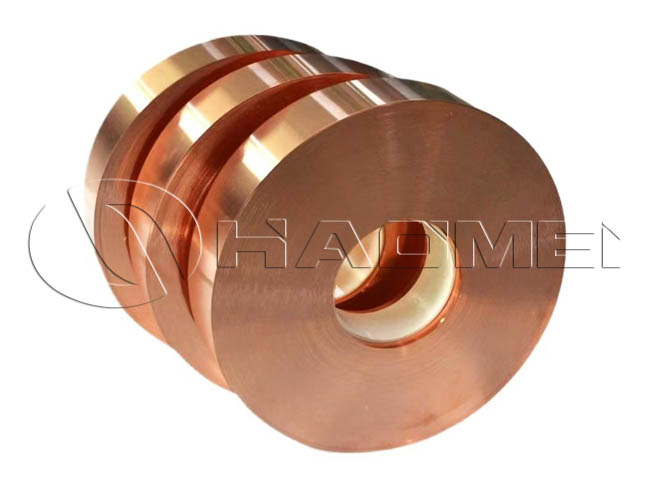
Among various conductive materials, high-conductivity pure copper strip is widely used in the manufacture of oil-immersed transformers, dry-type transformers, power transformers, distribution transformers, and renewable energy transformers. With conductivity close to 100% IACS (International Annealed Copper Standard), it provides outstanding electrical performance for demanding transformer winding applications.
High-quality transformer winding copper strip not only reduces electrical energy losses, but also lowers operating temperature rise, improves transformer efficiency, and extends service life. It is therefore a fundamental material for modern high-performance transformer manufacturing.
What Is 100% IACS?
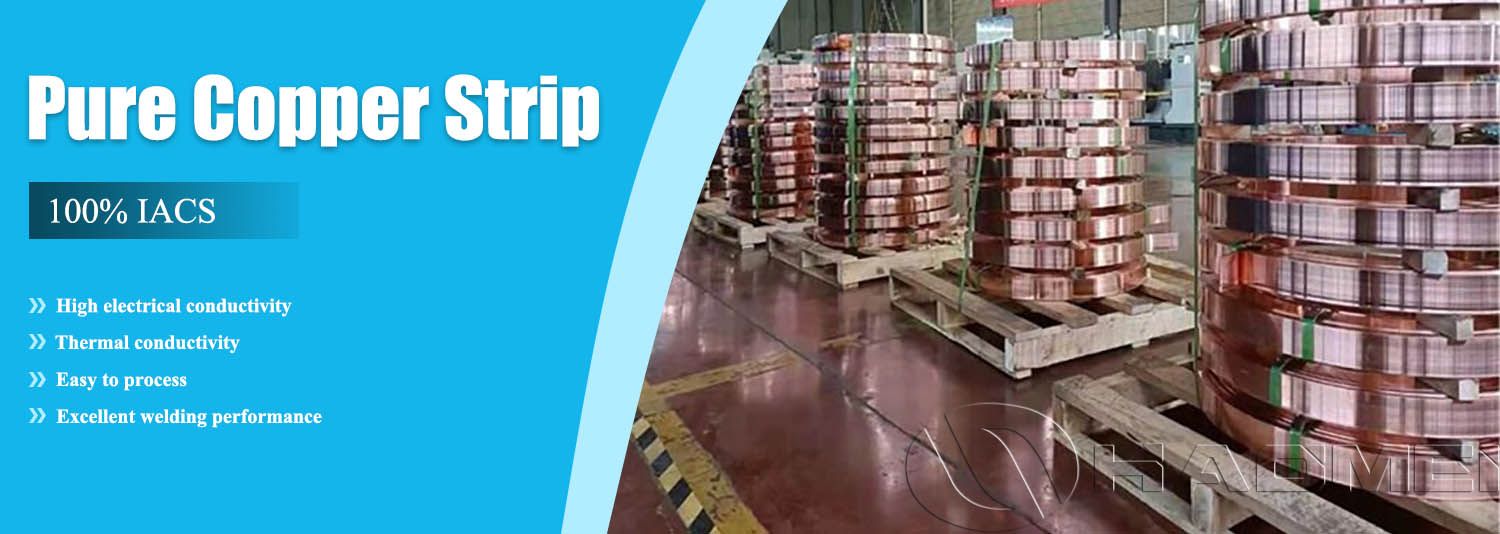
IACS stands for International Annealed Copper Standard, a widely recognized benchmark for measuring the electrical conductivity of metallic materials.
Under the IACS system, the conductivity of standard annealed pure copper at 20°C is defined as 100% IACS, corresponding to an electrical resistivity of approximately:0.017241 Ω·mm²/m
The higher the conductivity, the lower the resistance to electric current. Conversely, lower conductivity means higher electrical resistance, which results in greater energy loss and heat generation during operation.
For transformer windings, the conductivity of copper strip directly affects winding resistance, load loss, operating temperature rise, and overall transformer efficiency.
Pure Copper Strip for Transformer Windings
Common copper grades used for transformer winding strip include TU1 oxygen-free copper and T2 pure copper. In general, TU1 copper can achieve conductivity of ≥100% IACS, while T2 copper typically offers conductivity of ≥98% IACS.
Among them, C11000 copper strip is one of the most commonly used materials in transformer manufacturing because it provides an excellent balance of high conductivity, good processing performance, and cost-effectiveness.
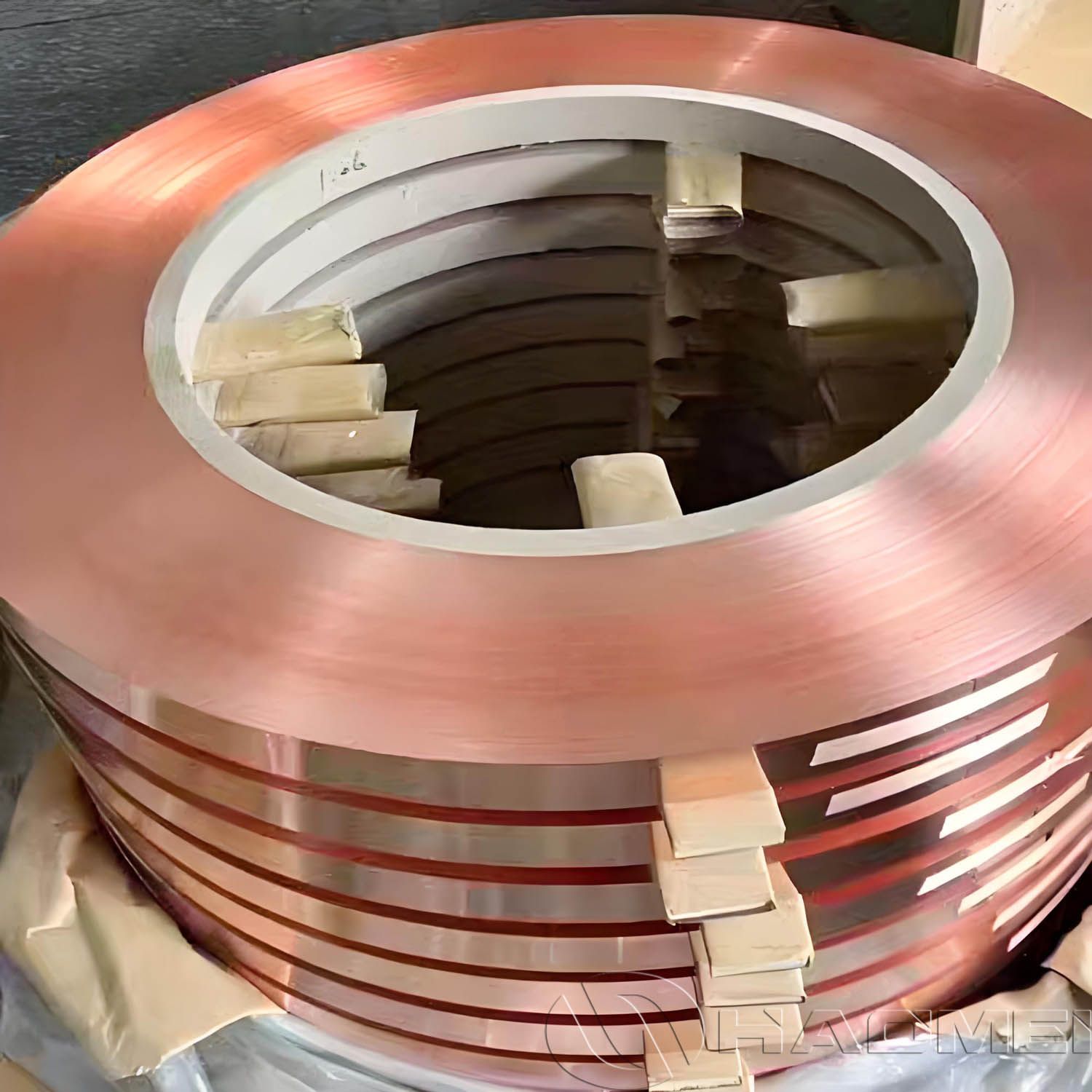
Transformer copper strip is typically available in thicknesses ranging from 0.1 mm to 2.5 mm, with widths up to 1000 mm. High-precision dimensional control affects not only the space utilization of the winding, but also the electrical performance, winding consistency, and reliability of the transformer.
Core Advantages of High-Conductivity Pure Copper Strip for Transformer Windings
1. Exceptional Electrical Conductivity
With conductivity of ≥100% IACS—and in some cases reaching 101% to 102% IACS—high-conductivity copper strip has extremely low electrical resistivity. This directly reduces winding copper loss, also known as load loss, and improves the overall energy efficiency of the transformer.
As a general reference, every 1% increase in conductivity can reduce load loss by approximately 0.5%, delivering significant energy-saving benefits throughout the transformer’s service life.
2. Improved Resistance to Skin Effect
Compared with round wire, flat copper strip provides a more uniform current distribution under high-frequency and high-current conditions. This helps reduce additional losses caused by the skin effect and proximity effect.
For this reason, copper strip is particularly suitable for high-capacity and high-frequency transformer applications.
3. Excellent Thermal Conductivity and Heat Dissipation
Copper has a thermal conductivity of approximately 401 W/(m·K), which is substantially higher than that of aluminum, at approximately 235 W/(m·K).
This excellent thermal performance allows heat generated in the winding to be transferred away more quickly, helping to reduce hot-spot temperature rise, slow insulation aging, and ensure safe, stable long-term operation.
4. High Mechanical Strength and Short-Circuit Withstand Capability
Pure copper strip offers high tensile strength and good toughness. When tightly wound, it forms a winding structure with excellent rigidity and mechanical stability.
During short-circuit events, transformer windings are exposed to significant electromagnetic forces. High-quality copper strip can better withstand these forces without excessive deformation or breakage, providing reliability superior to aluminum windings in many demanding applications.
5. Excellent Formability and Weldability
Copper strip has good cold-bending and winding characteristics. It can be processed smoothly during coil winding and offers stable welding performance.
This allows reliable connections between winding terminals, lead wires, and copper foil or strip sections, making it well suited for automated transformer production lines.
6. Long-Term Creep Resistance and Corrosion Resistance
Copper has strong resistance to creep under long-term thermal cycling, helping prevent loosening at winding connections over time. When combined with proper anti-oxidation treatment, copper strip also provides good corrosion resistance in normal atmospheric environments, including moderately humid conditions.
These characteristics support stable operation over decades while reducing maintenance requirements and lifecycle costs.
Transformer Winding Copper Strip Specifications
| Item | Common Range |
| Thickness | 0.05–5.0 mm |
| Width | 10–1000 mm |
| Copper Grade | C11000, T2, C10100 |
| Temper | O Temper, H Temper |
| Electrical Conductivity | ≥100% IACS |
Key Quality Indicators for Transformer Winding Pure Copper Strip
| Quality Dimension | Quality Requirement | Impact on Transformer Performance |
| Electrical Conductivity | 100% IACS | Directly affects electrical transmission loss and winding resistance |
| Edge Treatment / Burr Control | Burr-free, rounded edges, or micro-polished edges | Burrs may puncture thin insulation films and cause interlayer short circuits. High-quality copper strip must undergo strict deburring or edge-rounding treatment. |
| Thickness and Width Tolerance | High-precision, micron-level tolerances | Ensures consistent winding height and dimensions while preventing localized stress concentration and high-voltage discharge. |
| Surface Finish | Oxide-free, oil-free, smooth, and highly flat | Ensures close contact with insulating paper or film and helps prevent micro air gaps that can trigger partial discharge. |
| Annealing Condition / Temper | Soft annealed condition, such as O60 / Soft Annealed | Provides high ductility and flexibility, minimizes springback during winding, and enables compact coil construction. |
Applications of 100% IACS High-Conductivity Pure Copper Strip
Dry-Type Transformers
High-conductivity copper strip is a standard core material for low-voltage foil windings in dry-type transformers. Its high conductivity and excellent winding performance help control temperature rise and improve energy efficiency.
Renewable Energy Applications
Copper strip is widely used in transformers for photovoltaic inverters, wind power step-up transformers, and energy storage systems, where efficiency, compact design, and long-term reliability are essential.
Special and Industrial Transformers
Typical applications include:
Rectifier transformers
Electric furnace transformers
Railway traction transformers
High-current industrial transformers
Mining transformers
Test transformers
Data Centers and Smart Grids
High-efficiency distribution transformers used in data centers and smart grid systems benefit from low-resistance copper windings. These materials help reduce energy loss and support lower PUE values in high-density computing facilities.
Common Issues When Using High-Conductivity Copper Strip and Their Solutions
1. Copper Strip Surface Oxidation
Light oxidation on the surface of copper strip can affect appearance and welding quality. In severe cases, it may also increase contact resistance.
Recommended solutions:
Inspect packaging integrity before use;
Keep the storage area dry and well ventilated;
Avoid prolonged exposure to humid air;
Follow the first-in, first-out inventory principle;
Clean connection areas as required before welding or joining;
Select products with reliable anti-oxidation packaging.
2. Insulation Damage Caused by Sharp Edges During Winding
If copper strip has burrs, sharp edges, or edge defects, it may damage insulation paper or film during the winding process.
Recommended solutions:
Clearly specify deburring requirements when purchasing;
Use round-edge or chamfered copper strip;
Adjust winding tension appropriately;
Inspect guide rollers and pressure rollers regularly;
Clean metal debris from winding equipment on a routine basis.
3. Uneven Winding Caused by Thickness Variation
Inconsistent strip thickness can create cumulative layer-to-layer errors, affecting winding dimensions, inter-turn pressure, and insulation integrity.
Recommended solutions:
Select suppliers with stable dimensional tolerance control;
Perform incoming thickness inspections on a sampling basis;
Apply tighter tolerance requirements for critical windings;
Establish batch quality evaluation procedures for suppliers.
4. Excessive Transformer Loss Caused by Insufficient Conductivity
If copper strip conductivity is unstable or impurity content is too high, winding resistance may increase. This can result in higher load losses and may cause the finished transformer to fail performance tests.
Recommended solutions:
Test electrical resistivity for critical material batches;
Review material certificates and conductivity test reports;
Avoid replacing high-conductivity copper with low-cost, lower-grade alternatives;
Establish incoming material inspection standards;
Conduct long-term supplier quality audits.