 Contact Us
In the fields of power transmission and communication engineering, the safety and stability of cables are extremely important. Especially in complex electromagnetic environments or applications with high anti-interference requirements, traditional steel tape armoring has gradually exposed problems such as magnetic interference, heavy weight, and insufficient corrosion resistance.
Among many armoring materials, 5052 and 5154 aluminum alloy strips have become the dedicated and preferred materials for non-magnetic armoring of large-section single-core AC cables, marine cables, and high-end industrial control cables, thanks to their non-magnetic properties, lightweight structure, excellent corrosion resistance, and high mechanical strength.
Material Introduction
5052 and 5154 aluminum alloys both belong to the 5000 series Al-Mg alloys. Their magnesium content is generally between 2.2% and 3.6%, and magnesium is the main alloying element.
Unlike 2000 series or 6000 series alloys, which rely on heat treatment for strengthening, 5000 series alloys are mainly strengthened through solid solution strengthening of magnesium and cold working hardening. Therefore, they are known as non-heat-treatable aluminum alloys.
Temper Conditions
H32 Temper, 1/4 Hard, Stabilized
This is the most commonly used temper for armored cable applications. Its tensile strength can usually reach 228–280 MPa, the yield strength is not less than 193 MPa, and the elongation is about 12%.
This temper provides both high strength and excellent bending formability, making it very suitable for spiral wrapping or interlocked armoring processes.
H34/H36 Temper, Half-Hard / 3/4 Hard
When the cable needs to withstand greater radial pressure or is used in harsher mechanical environments, higher-strength tempers can be selected. In this case, the yield strength can be further increased to more than 220 MPa, meeting the requirements of heavy-duty industrial cables.
In comparison, 5154 aluminum strip usually has slightly higher magnesium content than 5052 aluminum strip, so it often offers better strength performance and is suitable for special cables requiring higher mechanical protection levels.
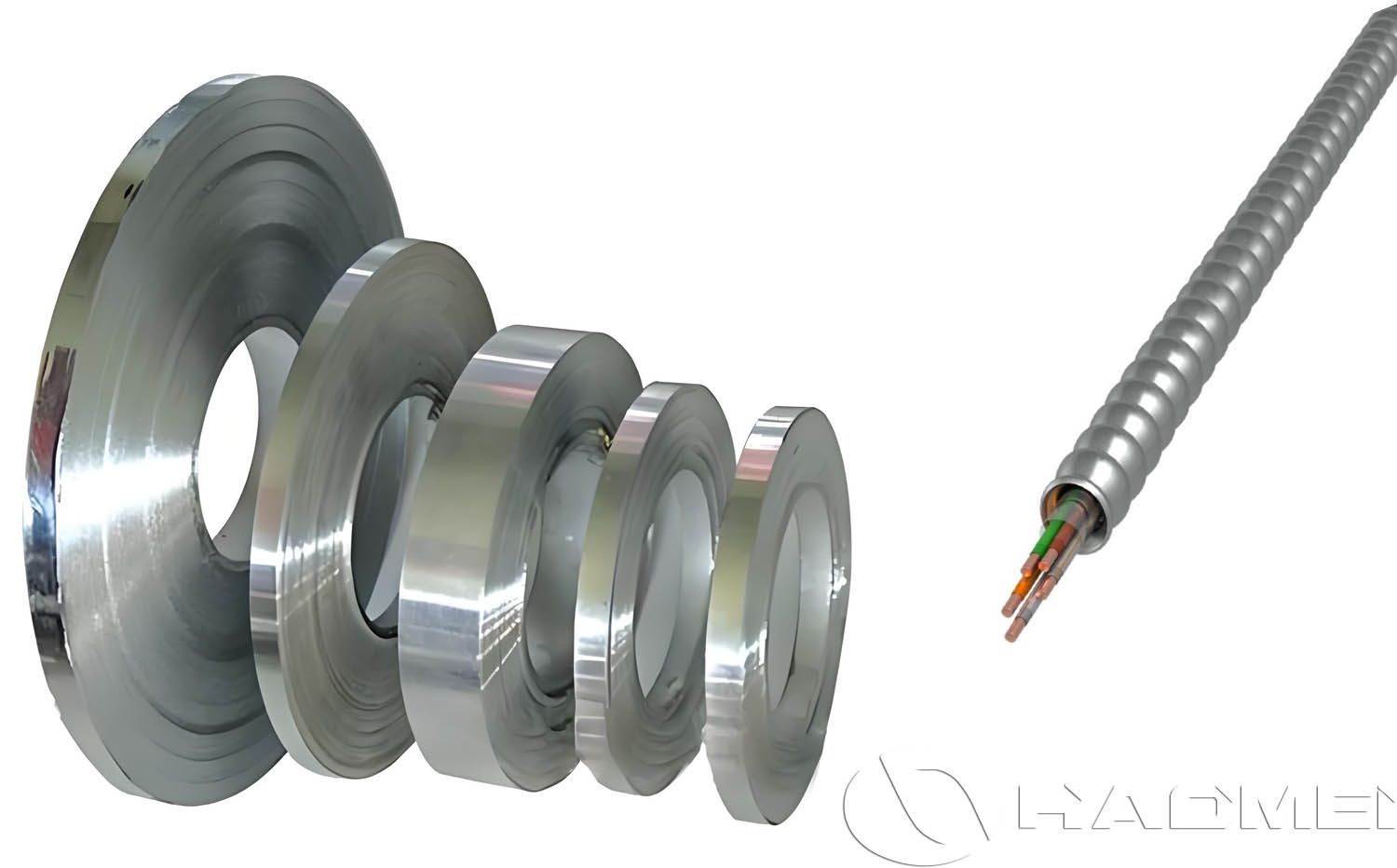
Why Must Single-Core AC Cables Use "Non-Magnetic" Armoring?
Traditional cables, such as three-core cables, usually use galvanized steel tape, which is a magnetic material, for armoring.
However, in single-core AC cables, alternating current generates an alternating magnetic field around the conductor. If ferromagnetic materials such as steel tape or steel wire are used for closed armoring, huge eddy current loss and hysteresis loss will be generated in the armoring layer.
This causes severe cable heating, which not only greatly reduces the current-carrying capacity and transmission efficiency of the cable, but may also accelerate insulation aging and create fire hazards.
Therefore, national and international cable standards, such as IEC and GB standards, strictly require that the metal armoring of single-core AC cables must be made of non-magnetic materials.
5052 and 5154 aluminum alloy strips are outstanding and irreplaceable materials in this field.
Technical Parameters of Aluminum Strip for Armored Cable
| Category | Technical Item | Specification / Standard Value |
| Basic Information | Product Name | Cable Armoring Aluminum Strip |
| Alloy Grade | 5052 / 5154, 5000 series Al-Mg alloy | |
| Supply Temper | H14, H24, H19, O temper, customizable | |
| Dimensions | Thickness Range, mm | 0.20 – 1.00, thickness tolerance: ±0.02 mm |
| Width Range, mm | 10.0 – 100.0, width tolerance: ±0.1 mm | |
| Coil Inner Diameter, ID | 150 mm / 200 mm / 300 mm | |
| Coil Outer Diameter, OD | 600 mm – 1200 mm, according to customer requirements | |
| Mechanical Properties | Tensile Strength Rm, MPa | 170 – 240, depending on temper |
| Yield Strength Rp0.2, MPa | ≥120 | |
| Elongation after Fracture A50mm, % | ≥8% | |
| Physical & Chemical Properties | Magnetic Property | Completely non-magnetic, ferromagnetic loss = 0 |
| Appearance Quality | Slitting Edge Quality | Neat end face, no collapsed coils, no misalignment; burr-free edges to prevent puncturing the insulation layer |
| Surface Cleanliness | No obvious oil stains, no aluminum powder, no obvious scratches, good oxidation resistance | |
| Standards Compliance | Industry & Environmental Standards | Complies with GB/T 3880, ASTM B209, RoHS, REACH certification |
Core Performance Advantages of 5052 and 5154 Aluminum Strip
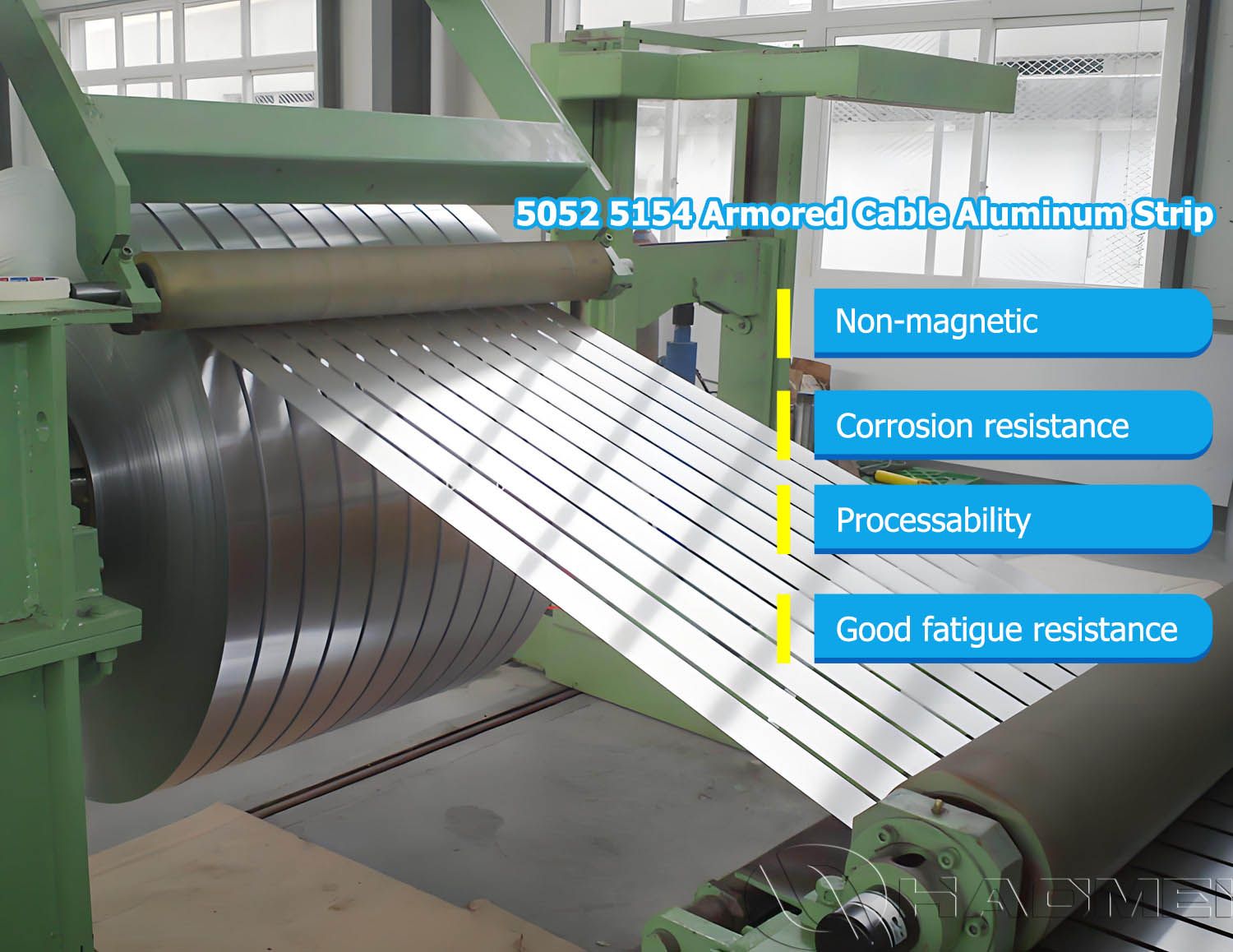
1.Strong Weather Resistance
The strip surface can quickly form a dense aluminum oxide protective film, providing excellent resistance to moisture, acid rain, and salt spray corrosion.
2.High Mechanical Strength
Compared with 1000 series pure aluminum strip, 5052 and 5154 aluminum strips achieve significantly improved tensile strength and yield strength through magnesium solid solution strengthening.
3.Excellent Processing Elongation
After precise annealing treatment, usually in H14, H24, H19, or O temper, the aluminum strip maintains good elongation and flexibility. It can perfectly adapt to high-speed cable interlocked armoring or wrapping processes, with good stamping continuity and low risk of strip breakage or cracking.
4.Non-Magnetic Performance
5052/5154 aluminum alloys are completely non-magnetic metals. During the operation of single-core AC cables, they do not generate hysteresis loss and can significantly suppress the generation of eddy currents.
This ensures that cables remain stable and cool during ultra-high-voltage and high-current transmission, minimizing power loss in the line.
5.Lightweight Economic Benefits
The density of aluminum is only about one-third of that of steel. Replacing steel tape with 5052/5154 aluminum strip for armoring can greatly reduce the overall weight of the cable.
This not only lowers the difficulty of cable transportation and long-distance laying, but also reduces the load requirements for cable trays and supporting structures.
Key Quality Control Points for Aluminum Strip Used in Armored Cables
To ensure stable performance during continuous cable wrapping and armoring, high-quality 5052/5154 aluminum strips must meet the following strict process requirements:
Extremely Small Thickness and Width Tolerances:The armoring process requires highly precise aluminum strip dimensions. The thickness tolerance usually needs to be controlled within ±0.02 mm, and the width tolerance within ±0.1 mm, to prevent die jamming or incomplete wrapping during high-speed armoring.
Flat Shape, No Wavy Edges:The aluminum strip must have excellent flatness. If wavy edges or warping exist, unstable locking or edge lifting may easily occur during interlocked armoring.
Neat Slitting Edge, No Burrs:This is especially critical. If burrs exist on the aluminum strip edge, they may easily puncture the cable inner lining or insulation layer during wrapping or interlocked forming, causing the finished cable to fail the voltage withstand test.
High Surface Cleanliness:The surface should be free from obvious oil stains, aluminum powder, and scratches. This helps ensure stable contact resistance between armoring layers and is also beneficial for the extrusion bonding of the cable outer sheath, such as PVC or PE.
Applications of 5052/5154 Aluminum Strip
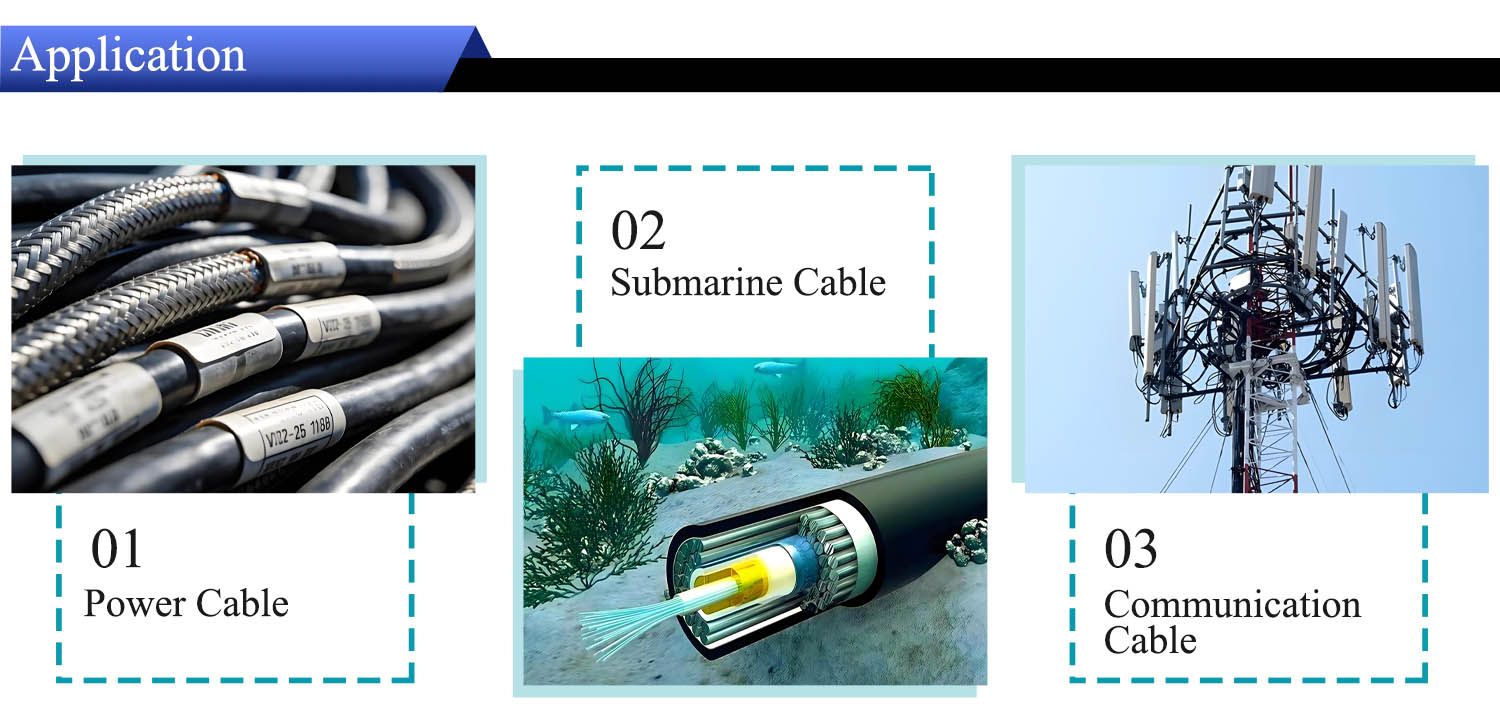
Power cable armoring, medium and high-voltage cables
Protective layers for communication cables and optical cables
Submarine cables and marine engineering cables
Mining cables, with compression and corrosion resistance
Rail transit and new energy cable systems
5052/5154 Aluminum Strip Armoring Compared with Traditional Materials
1. Compared with Steel Tape Armoring
Traditional steel tape has strong magnetism, high electromagnetic loss, and severe cable heating problems. It is mainly suitable for ordinary low-voltage civil lines.
At the same time, steel is heavy and prone to rust. In coastal or humid environments, additional anti-corrosion treatment is required.
Al-Mg aluminum strip is non-magnetic, lightweight, and naturally rust-resistant. It provides a comprehensive upgrade in terms of performance, energy consumption, and maintenance, making it the preferred material for replacing steel tape in high-end non-magnetic cables.
2. Compared with Pure Aluminum Strip
1060 pure aluminum strip is relatively soft, with insufficient mechanical protection capability and poor resistance to compression and impact. It cannot provide heavy-duty armoring protection.
5052/5154 aluminum strips, strengthened by magnesium alloying, offer greatly improved strength. Their protection level fully meets the requirements of industrial cable applications while maintaining both formability and protective performance.
Summary
From the perspective of the whole life cycle, aluminum strip armored cables offer lower operating energy consumption, fewer failures, and simpler maintenance.
On the production side, they are compatible with automated production lines and provide stable processing performance. On the engineering side, they are easier to install and require less supporting investment, delivering significant overall economic benefits.